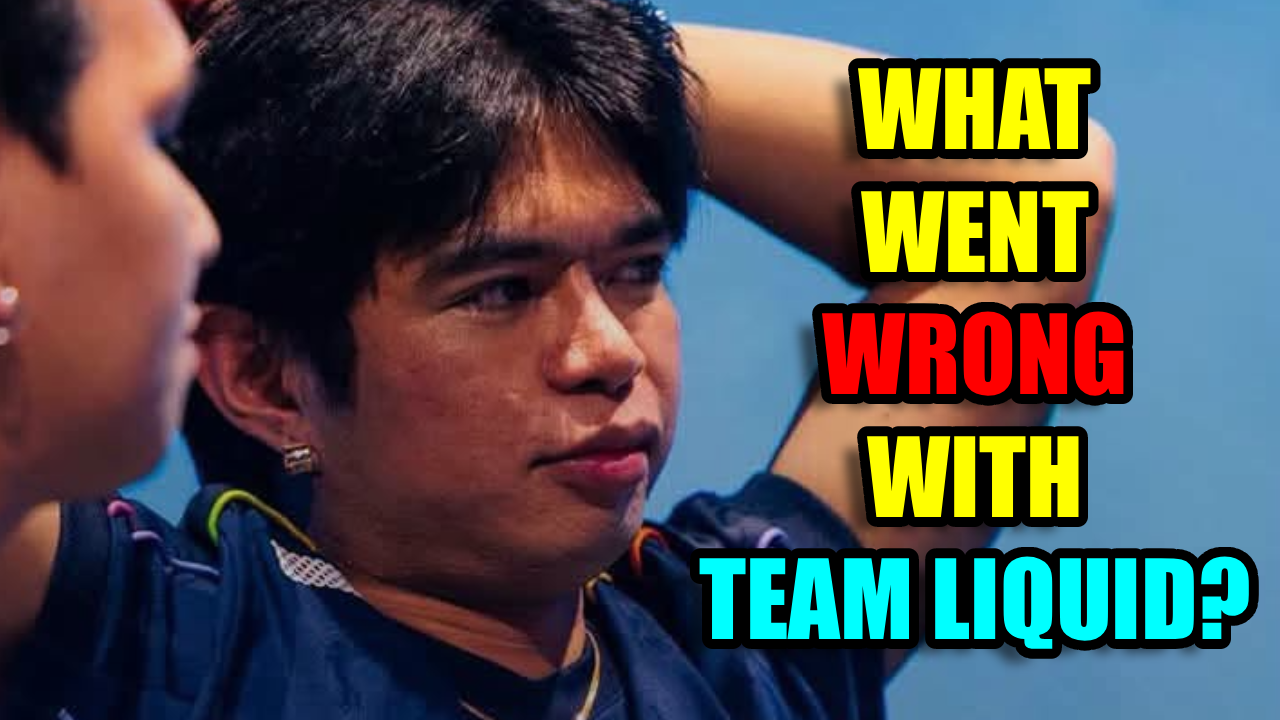
What Went Wrong at MSC 2026?
Almost nobody expected Team Liquid PH’s MSC 2026 title defense to end like this.
They arrived as the reigning MSC champions, fresh from making history as the first team to win three consecutive MPL Philippines championships. With their experience, disciplined macro, and proven ability to perform under pressure, Team Liquid PH looked like one of the safest picks to make another deep international run.
Instead, they were eliminated before the playoffs without winning a single series.
Losses to Aurora Türkiye and Entity7 brought their championship defense to a sudden end and produced one of MSC 2026’s biggest surprises.
So, what actually went wrong?
There isn’t one player, draft, or mistake that explains everything. Team Liquid’s elimination came from several smaller problems appearing at the same time, while their opponents were prepared enough to punish nearly all of them.
Team Liquid PH MSC 2026 Struggled to Control the Tempo
One of Team Liquid’s biggest strengths throughout MPL Philippines Season 17 was their ability to dictate how games were played.
They weren’t restricted to one style. They could slow matches down through disciplined macro, accelerate through aggressive skirmishes, or draft scaling compositions and patiently wait for their win condition.
That flexibility made preparing against them incredibly difficult.
But Team Liquid PH MSC 2026 looked different.
Against Aurora Türkiye, the defending champions suddenly found themselves reacting rather than dictating.
Aurora’s unconventional mid-lane Rafaela became an immediate problem. Sanji later acknowledged that it wasn’t something Team Liquid had encountered during scrims, leaving them with an unfamiliar challenge to solve while the series was already underway.
That gave Aurora an opportunity to establish the tempo instead.
Aurora Türkiye Forced Team Liquid Into Unfamiliar Territory
The Rafaela pick wasn’t dangerous simply because it was unexpected.
It disrupted Team Liquid’s preparation.
International tournaments often reward teams willing to introduce strategies that force established favorites away from familiar patterns. Instead of Team Liquid making Aurora respond to their game plan, the Philippine champions suddenly had to find answers in real time.
That shift became even more important around objectives.
Aurora consistently found early neutral objectives, including multiple Turtles and the first Lord in Game 2. Each objective created additional map pressure and prevented Team Liquid from settling into the controlled mid game where they traditionally excel.
One series loss wasn’t enough to end their tournament.
The bigger problem was that many of those issues followed them into the next match.
Why Team Liquid Lost Was Bigger Than One Bad Draft
When a championship favorite gets eliminated, draft criticism usually arrives immediately.
Some of it is understandable.
Team Liquid occasionally moved away from the comfortable combinations that had helped define their domestic success. Against Entity7, certain compositions struggled to consistently threaten the opposing frontline or reach favorable late-game situations.
But saying the draft alone explains why Team Liquid lost would oversimplify what happened.
A composition only succeeds when the players can execute its win condition.
Several of Team Liquid’s drafts demanded extremely precise coordination. Engages needed immediate follow-up, objective setups had to be clean, and every player needed to arrive at crucial fights at exactly the right moment.
At MSC, those details weren’t consistently there.
Execution Problems Made Every Mistake More Expensive
Team Liquid didn’t suddenly lose its mechanical ability.
The problem was synchronization.
Rotations occasionally arrived slightly late. Objective contests weren’t as controlled. Some initiations lacked the immediate follow-up normally associated with Team Liquid’s teamfighting.
Against weaker competition, those small mistakes might be recoverable.
Against international champions, they’re often decisive.
Entity7 demonstrated that perfectly.
During Game 1 of the elimination series, a crucial Lord fight around the seven-minute mark ended in a team wipe that handed the South American champions control of the game.
From there, Team Liquid was no longer setting the pace.
They were chasing it.
Entity7 and Aurora Türkiye Deserve Their Credit
Team Liquid’s elimination shouldn’t be framed solely around what the defending champions did wrong.
Their opponents played exceptionally well.
Aurora Türkiye entered MSC after establishing itself as a dominant force domestically. Rather than approaching Team Liquid cautiously because of the Philippine team’s reputation, Aurora introduced its own ideas and trusted them.
Entity7 did something similar.
The Peruvian champions showed no signs of being intimidated by Team Liquid’s history. They pressured aggressively, contested important areas of the map, and punished overextensions whenever the defending champions attempted to force the tempo.
That confidence reflects one of the biggest changes happening in international Mobile Legends.
Emerging regions no longer enter these matches simply hoping to survive.
They’re trying to win them.
The MSC 2026 Upset Shows How Much Global MLBB Has Changed
The MSC 2026 upset involving Team Liquid PH may ultimately become important for reasons beyond one team’s elimination.
For years, Philippine representatives entered international tournaments carrying an intimidating reputation. Opponents often approached them cautiously because the Philippines had repeatedly established itself as the standard for competitive MLBB.
That reputation still matters.
But it no longer guarantees control of a series.
Aurora Türkiye and Entity7 both demonstrated that regional champions from outside Southeast Asia can now arrive with enough preparation, confidence, and structure to challenge the very best.
That changes the entire international landscape.
Adaptation Became Team Liquid’s Biggest Challenge
International tournaments move incredibly quickly.
A team may have weeks to prepare before arriving, but once competition begins, adjustments often need to happen overnight.
There isn’t always time to completely rebuild a strategy.
Coaches must identify what went wrong, find realistic solutions, and prepare players for an opponent with an entirely different style.
That was where Team Liquid struggled.
After the loss to Aurora, the team needed to reset quickly before facing Entity7. Yet similar issues involving tempo, map pressure, and objective control appeared again.
Their adjustments simply weren’t enough to completely change the direction of the tournament.
Why Team Liquid Lost Control Between Series
The short turnaround between international matches makes recovery difficult.
Team Liquid wasn’t only preparing for a new opponent. They were also trying to fix problems exposed in the previous series.
Entity7 then presented an entirely different challenge.
Instead of Aurora’s unconventional approach, Team Liquid faced a team willing to create pressure constantly and trust itself in chaotic situations.
That forced the defending champions to solve new problems before fully addressing the old ones.
Against a field this competitive, there simply wasn’t enough margin for error.
One Tournament Doesn’t Erase Team Liquid PH’s Legacy
An early exit will naturally create questions.
But it shouldn’t erase what Team Liquid has already accomplished.
This is still an organization that entered MSC as the defending champion and had just completed an unprecedented MPL Philippines three-peat.
One poor international tournament doesn’t suddenly make that success irrelevant.
What the elimination does create is a new challenge.
For the first time in a while, Team Liquid PH must respond to a major setback rather than build on another championship.
How they react may become more important than the elimination itself.
What Really Caused Team Liquid PH’s Elimination?
There wasn’t one reason.
Team Liquid PH’s title defense unraveled because several problems appeared simultaneously.
Their opponents disrupted their preferred tempo. Objective control became inconsistent. Execution wasn’t as synchronized as it had been domestically. Some drafts demanded extremely precise coordination, while Aurora Türkiye and Entity7 arrived with clear strategies and enough confidence to execute them.
Most importantly, Team Liquid couldn’t adapt quickly enough before another international opponent exposed similar weaknesses.
That doesn’t mean their championship era is over.
What it does mean is that international Mobile Legends has become much less forgiving.
Teams from Türkiye, the Americas, East Asia, and other emerging regions are investing more heavily in coaching, preparation, analytics, and player development. The gap between established powers and rising regions continues to shrink.
Team Liquid PH’s elimination may therefore be remembered as more than one shocking upset.
It could become one of the clearest signs yet that reputation alone no longer makes anyone safe on the international stage.
What Do You Think?
What was the biggest reason behind Team Liquid PH’s early MSC 2026 exit?
Was it their drafting, execution, difficulty adapting to the tournament meta, or were Aurora Türkiye and Entity7 simply the better teams when it mattered?
And after this setback, what changes should Team Liquid PH make before their next international tournament?
PakarPBN
A Private Blog Network (PBN) is a collection of websites that are controlled by a single individual or organization and used primarily to build backlinks to a “money site” in order to influence its ranking in search engines such as Google. The core idea behind a PBN is based on the importance of backlinks in Google’s ranking algorithm. Since Google views backlinks as signals of authority and trust, some website owners attempt to artificially create these signals through a controlled network of sites.
In a typical PBN setup, the owner acquires expired or aged domains that already have existing authority, backlinks, and history. These domains are rebuilt with new content and hosted separately, often using different IP addresses, hosting providers, themes, and ownership details to make them appear unrelated. Within the content published on these sites, links are strategically placed that point to the main website the owner wants to rank higher. By doing this, the owner attempts to pass link equity (also known as “link juice”) from the PBN sites to the target website.
The purpose of a PBN is to give the impression that the target website is naturally earning links from multiple independent sources. If done effectively, this can temporarily improve keyword rankings, increase organic visibility, and drive more traffic from search results.

Related Posts

Smart Redefines 5G Leadership with the HUAWEI Pura 90s Series

De bijen van PenH – Geocache of the week – Official Blog